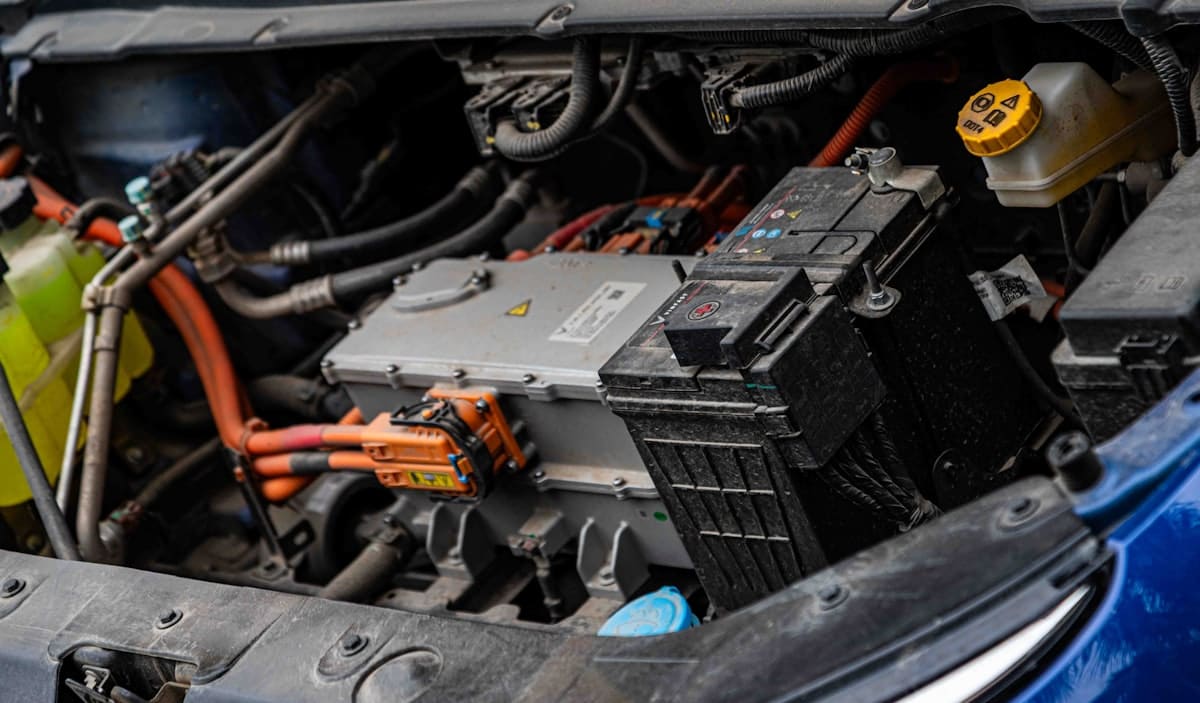
EV & high-voltage battery harness design
High-voltage harness design for EV powertrain, battery pack interconnect and electric off-highway — designed-in safety from the first routing pass.
Deliverables and scope
Each engagement is priced and scoped before we start — no scope creep, no surprises.
-
HV / LV separation by design
Orange-cable HV routes laid out separately from LV looms, with minimum separation distances enforced at the routing stage.
-
Shielded routing in 3D
Shielded HV harness routing modelled in 3D — bend radii, drip loops, service-disconnect access, busbar interfaces.
-
Isolation + insulation spec
Insulation class, isolation resistance targets, creepage and clearance documented per connector and per cable.
-
Safety-case ready
Design artefacts written so they slot into the safety case — failure-mode notes, segregation rationale, test-feature list.
From brief to sign-off
- 01
Architecture review
Pack topology, motor count, BMS layout, service disconnect, charge port. We build the harness story around the architecture, not the other way around.
- 02
HV routing
Orange cables routed first, in 3D, with isolation distances enforced. LV looms designed to fit around them, not vice versa.
- 03
Safety hooks
Service disconnects, interlock loops, isolation monitoring points — placed for access at first build and for service over life.
- 04
Release
HV harness pack — schematic, 3D, BOM, spec, test plan, segregation evidence — handed to your HV manufacturer.
Common questions
Which HV safety standards do you design to?
ECE R100 for road EVs, ISO 6469-3 for electric road-vehicle safety, IEC 60664 for insulation coordination, ISO 17409 for charging interfaces. Off-highway adds ISO 19014 functional safety considerations. We work to the standards your programme is certifying against.
Do you do the HV safety case yourself?
No — the safety case is your homologation team's deliverable. We provide the harness-side evidence in the format their case needs: segregation distances, isolation values, materials, test-feature definitions.
Can you support 800-volt programmes?
Yes. The design rules tighten — clearance, shielding, partial-discharge resilience — but the workflow is the same. Talk to us about your pack voltage and we will tell you what changes in the design rules.
Do you design battery internal interconnects (busbars, ICB) as well as the pack-to-vehicle harness?
Cell-to-cell busbar work is normally inside the battery vendor's scope. Pack-to-vehicle and module-to-module is in ours. The handover point between the two is one of the first things we agree.
What about electric off-highway?
Yes. Electric construction plant, agricultural machinery and heavy-plant electrification all use the same HV harness disciplines, with additional sealing and harsh-environment constraints. See the Off-Highway sector page.
Start your harness design.
Send us your scope. We'll come back with a costed plan and a delivery timeline within two working days.